Tuesday, 6 March 2018

Power and Authority comparison


Power and Authority:

One Flew Over:

America has long made heroes of figures who assert their individuality, yet many American novelists have written about characters whose individualism conflicts with the societies around them. The character of Mcmurphy is also incongorous with the institution that he has been put into, as he represents the life and colour of the outside world, and the institution however is bereft of colour and joy. therefore Mcmurphy is presented as non-conformist and unwilling to accept authority. his non-conformity is evident in the first therapy scene where he is wearing colour whilst the other characters and the building is all white and dull.   
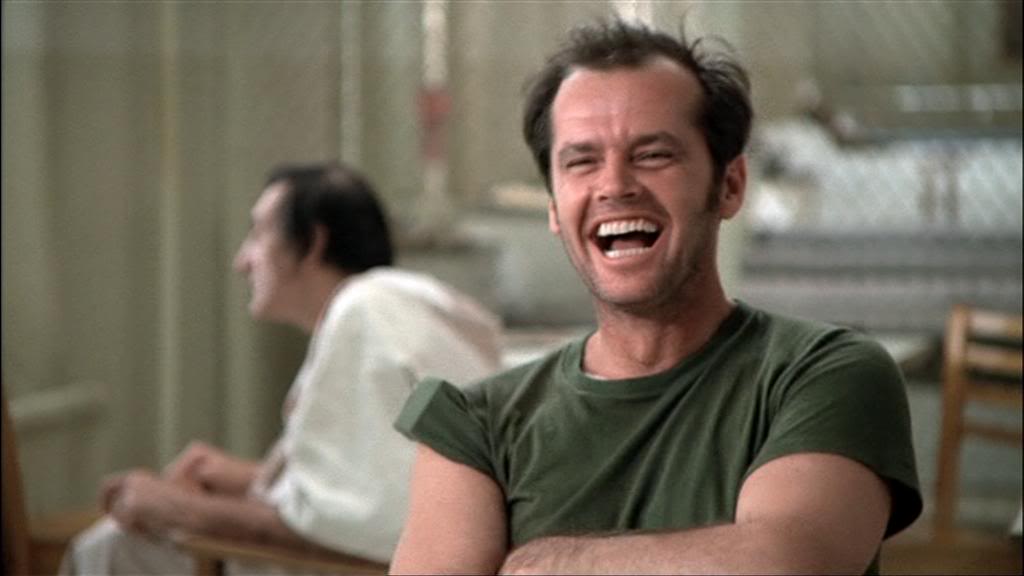
Image result for ofotcn therapy scene  


Image result for ofotcn therapy scene


McMurphy is destruction to the status quo. he doesn't respect authorial figures e.g. when he addressed the doctor his language is informal. another example is his relationships with nurse Ratchet, as he is always the one questioning her power and decisions e.g. his demand to watch the world series. also when he enters the nurses office without permission. Nurse Ratchets unwillingness to allow patients to watch the world series shows the abuse of her power.
The film is notable for having men existing in a passive relationship with at leat one authoritative and controlling woman. she comes across as dominant when she is challenged. she is presented as the antagonist who thwarts McMurphy's goals and hope.
Forman previous film banned in his own country for shining a negative light on communism. this can be presented when Nurse Ratchet ignores the democratic vote of the patients, which can be linked to communism. power and authority is gained by the fear of nurse Ratchet.
Schatz argues that characters are now the main focal point in films whereas in classical Hollywood characters merely influenced the story line.

Vertigo:


In Vertigo power and authority are represented in a variety different ways in their text. One of the ways Vertigo does this is through the main character Scottie, Scottie is shown as a male authoritative figure throughout the film with his dominant expression and approach to women. One scene where this is very clear is when Scottie jumps into the river to save Madeline and the scene that follows, Scottie is shown as an Authoritative figure here because he takes action immediately jumping in to save the women. During the 1950's women were seen as lower in power than men with men being the most powerful in society. Going to the scene after this Scottie took Madeline back to his house and she is left powerless laying in the bed whilst Scottie makes her some tea. A common theme shown by most Hitchcock films is having a Blonde girl in it, this was usually done because Alfred Hitchcock liked blonde women and saw them as a tool in his films, someone who doesn't have any power except through sexual persuasions. However this is shown to be different in Vertigo where we find out Madeline had aided in the murder of Gavin's wife, when we find this out we get a completely different outlook on women power within the film and how women act as a hidden power often unseen by the audience.
Furthermore Scottie's misplaced in society, this is most present in his attempt to regain his authority after he lost is when Madeline died. his attempt at regaining control is presented as desperate and sad when he forces Judy to Dye her hair so she looks identical to Madeline because of the illusion created by the idea of helping madeline helps Scottie see himself as an authoritative figure which the time of the film was seen as being manly. Scottie tries to grasp onto his authority to try to fell secure in himself. This can be linked to the context of the film as 1950's America was a time of fear in which men were desperately trying to hold onto their power partially due to the rise of the 2nd wave of the feminist movement and the wars America fought; men are trying to recapture an outdated sense of authority.
The film can be read as a study of men trying to re-assert their control over women in post war America. 


Monday, 5 March 2018

Auteur Forman and Hitchcock


Directors auteur traits. how they compare and contrast. 

Forman and Hitchcock can both be considered auteurs due to their distinguishable traits. however their styles are very different due to the period they were active in. 

Forman’s signature traits
-       Casual informality of camera framing and angles, suggestive of documentary- contrasts to Hitchcock's style, where he plans every shot. 
-       Seemingly spontaneous ‘candid camera’ style- catches actors off-guard- contrasts with Hitchcock's style, where he tells the actors exactly what to do and say in a particular scene.  
-       Social analysis – strong critiques of bureaucracy (The Fireman’s Ball)
-       Allegory (symbolic narrative) or satire (mockery) strongly underpinned by ‘realism’
-       Earlier works made use of non-professional actors and semi-improvised dialogue to present a view of working-class life free from the stereotypes of social realism.- However Hitchcock would hire well known stars for his films in order to attract as many viewers as possible. 

-       Stories of ordinary people whose individuality becomes apparent in group scenes


-Comparison between Forman and Hitchcock as an auteur- however in introduction make clear that Nicolson can also be seen as the auteur. 
- In many of his films, he has played the "eternal outsider, the sardonic drifter," someone who rebels against the social structure.

Hitchcock:

 - In Vertigo and other Hitchcock films, there are recurring images of mirrors. this portrays the idea of duel identities, which can represent Madeleine's change of identity throughout the film. this can also convey the lack of self identity that Americans were feeling at this point in history. after the war, when men returned from fighting, society became a lot less stable and secure. people lost much of their self identity due to these insecurities. 


Wednesday, 28 February 2018

Hitchcock and Forman influences


Hitchcock and Forman influences:

both Forman and Hitchcock were influenced by film movements and by the context of the time they were active. they both reflect their influences through their films, where they convey subject topics that were important during their time of film making, and their different style of films are reflected through the use of the camera and other details.

New Hollywood (American New Wave) began from the mid 1960s to early 1980s. this changed peoples approach to film making. Hitchcock was active from the 1920s-1970s, meaning he had elements of new Hollywood and modern film movements as well as old Hollywood. He brought elements from movements like the French New Wave and German Expressionism into the traditional Hollywood studio format. The new Hollywood movement often used narrative which often constructed with classical norms.

Vertigo:


Vertigo, like all Hitchcock films, was influenced by the art-film movement of the 1920s, which stressed experimentation and strong use of imagery. Early in his career, when Hitchcock worked at the UFA studios in Berlin, Germany, he absorbed the style of German Expressionism; whose method of exposing the inner life of characters through unusual camera angles, moody lighting, and exaggerated mise-en-scène (stage-setting) influenced much of Hitchcock’s work. this is visible in scenes that can be considered expressionistic, e.g. the first time Madeline is introduced, and the colour surrounding her is bright red and gold. Hitchcock’s Vertigo, in turn, influenced the French New Wave School of film.

The notion of Vertigo felt by Scottie acts as a metaphor for the insecurities and uncertainties of men in post war American society.

Notions of voyeurism and watching are felt throughout the film, significantly when filming Madelaine. The first scene that she appears in uses a tracking shot to track her movements through the restaurant. This links to Mulvey’s theory of the male gaze, as the tracking shot presents Scotties fascination and infatuation with her. The idea of the ideal woman is shown through the tracking shots, as it contrasts with the single fixed shots of Judy. The story line uses a McGuffin structure, which was typical or Hitchcock. When the camera shows Madeleine watching the painting, the audience is made to believe that this is of significance, and therefore diverts their attention away from the important ending. 

Sigmund Freud's influence on modern society in the 1900s had much influence over Hitchcock and Vertigo. the film consists of peoples inner thoughts and their psychological health. this can be seen in the film through the expressionist style, in which peoples internal thoughts and emotions were shown externally through colour or setting. A diverse range of expressive camerawork includes the dramatic dolly-zoom Vertigo shot, long tracking shots as Scottie follows the ghostly Madeleine and the circling sweep when Scottie passionately kisses the newly transformed Madeleine/Judy.  

silent film also had an influence on Hitchcock. he valued the importance of visual storytelling, through editing and framing. 

One Flew Over:

McMurphy represents joy and freedom away from an oppressive institution.  Although he ends up dying as a consequence of his rebellious actions against the repressive system, his soul is never killed. Through the Chiefs escape, his influence lives on and conveys the power of spirit over death and a system which seeks to thwart patients of freedom and represses individuality. A person’s spirit lives on in the actions and mind of the living.

 Throughout the film, faces are filmed behind wire mesh and bars to emphasize the hopelessness of captivity. The glass of the nurse’s station represents the barrier between the individual and power—a barrier the patients are forbidden to cross, even though it appears more transparent than bars.

Forman, the film’s director, was influenced by the French New Wave movement which began in Europe and was a popular style after the Second World War. This style included natural and raw features, which were desired by film viewers during the post war period.  The directors of French New Wave often drew attention from audiences by discontinuity, reminding them that they are watching a movie. They would also shoot on location, as they were against the studio style which was glossy and perfect. They replaced the glossy studio light with natural and available light. Unlike studio film-making which remixing the sound, French New Wave directors recorded the sound during shooting and did not do any correction. The protagonists in the French New Wave films were considered as anti-authoritarian, much like McMurphy. 

-The anti-establishment and individualistic message of the film was underlined by hiring of Milos Forman, Czech director who had lived in the USSR controlled totalitarian regime of his native country and had more familiarity with often very subtle techniques with which the free will of individual can be broken. Forman was instrumental in helping create the Czech New Wave – a liberal arts movement critical of despotic government and inspired by similar New Waves in other countries around the globe.


Tuesday, 20 February 2018

exam question


Exam question:

One Flew Over (released in 1975, based on book set in 1962) Vertigo (1958)

1  1)     Compare how far your chosen films reflect their different production contexts

Both vertigo and one flew over the cuckoos nest (OFOTCN) reflect their production context through miss-en-scene, cinematography and performance.

1       Vertigo to a significant extent reflects the production context, the influence of the German expressionist movement through exaggerated mise en scene and thought provoking lighting. Bright red colour is used where the character of Madeline is introduced. The colour red represents lust, love, harm and blood, the combination of the opposing emotions that are attached to the same colour forebodes the volatility and unpredictability of their relationship, and of Madeleine character. The rich gold lighting in this scene emphasises Scottie’s infatuation and admiration as the colour gold symbolises affluence and luxury, which reflects the elusive nature and rarity of Madeline. These extreme colours in the mise en scene represent the inner life of the characters which is the core idea behind German expressionism, thus Vertigo as a film in this respect strongly reflects its production context. Hitchcock was strongly influenced by the German expressionist movement, which began to emerge in the film industry immediately after world war one. early in his career, Hitchcock worked at a studio in Berlin, which is where he was influenced by the style of German expressionism. 

Similarly, one flew over also to a significant extent reflects the production context. Forman was strongly influenced by the French new wave movement, which in fact was influenced by Hitchcock's style of film. this style of film was present in Europe after the second World War. Forman was born in the Czech republic, which is where he was influenced by European film movements before he brought it to America. This new movement wanted a raw and real feel to their films and this was often depicted through natural lighting and colour in this movement. this style is noticeable in the first group therapy session, where natural high key lighting provides an intense brightness which focuses the spectator’s attention on the moment and forces them to focus on the character’s facial expressions rather than any other distractions. The natural lighting gives the scene a raw and genuine expression which reflects the typical aspects of French new wave films, thus OFOTCN strongly reflects its production context in this sense. 

Vertigo reflects the context of the 1950’s/1960’s prominent feeling expressed by men after world war 2, as they experienced a lack of control which they formally held before the war. World war 2 left American society full of anxiety, discomfort and uncertainty, as when men were at war, women had to uphold order in society by taking on significant roles and thus gained more power and strength, which many men found intimidating. This is depicted through the character of Scottie and desire to obtain Madeline, as he seeks to have control over something significant and substantial in his life. this is shown through the constant reference and inclusion of spiral staircases in the mise en scene, for example the scene where Scottie chases Madeline up the spiral staircase symbolises the lack of control felt by Scottie. the symbol of the spirals represents Scotties spiral out of control and into a sense of powerlessness. the recurring spiral staircase image strongly reflects the lack of control men felt when returning from war in post war American society. the whole notion of Vertigo in fact, acts as a metaphor for uncertainty and insecurity. therefore through the themes of dizziness and Scotties insecurity, strongly reflects, and acts as a metaphor for society's uncertainties after the war.  

One flew over the cuckoos nest also presents its context through the power divisions between the characters. the black nurses controlled and held power over white patients. this portrays the freedom that black people were beginning to experience in america in 1975. this is shown through the facial expressions of the nurses when they talk to the patience. they express anger and dominate which suggests a role reversal, as black people were oppressed and looked down upon by white, male dominance previously. this is significantly presented during the pool scene when the nurse stands over Mcmurphy and tells him that he is going to be kept in the hospital for longer than he believes. the nurse is standing over Mcmurphy and therefore conveys his power over him and the other patience.through the low angle shot, the nurse literally takes power away from Mcmurphy by stripping his hope of freedom. this role reversal strongly reflects the context of 1975 America, where black people were only starting to experience equal rights and freedom.

furthermore, the notions of voyeurism and the male gaze presented in Vertigo was a common occurrence in film, especially during the 1950s, where womens roles within films would often be used only to covey ideas of lust and obsession. through the scene where Madeline is being watched by Scottie in the flower shop, the idea of the male gaze is presented. Hitchcock uses a wide angle full body shot when focusing on Madeline, and the audience are given the perspective of Scottie watching. this type of shot allows the audience to 'gaze' at Madeline's body through the eyes of Scottie, which conveys ideas of objectification and the 'male gaze'. the male gaze was commonly presented in films in order to objectify women and suggest that their only use to the film was their sexuality and appearance. Hitchcock's use of wide angle full body shots in his films can be suggested to reflect him as an auteur, as notions of voyeurism can be noted in many of his films, most significantly in 'rear window'. therefore, in this respect, Vertigo can be seen to strongly present its production context, as the use of full body shots and male point of view shots were commonly used in films during this period in order to present women as sexual objects of the male desire. however, due to the fact that Madeline holds power and dominance over Scottie due to her elusive nature and desirability, it can be argued that the representation of women in the film contrast with the context of this period, as women were usually depicted as submissive and vulnerable. Madeline however, is suggested to posses power, even if its through her sexuality. therefore it could be aruged that the full body shot was used in order to convey Madelines power and dominance, rather than to objectify her or diminish her to a sexual object.       


Sunday, 11 February 2018

changes in American film


Changes to American Film Industry:

the dramatic changes that occurred in film style over the decades are significant when looking at both Vertigo and One Flew Over. they have very visible differences, and these differences are a result of the cinematic changes. One Flew Over provides a much more natural and raw feeling than Vertigo. 

-post war period- people became desensitised to violence, and wanted a more raw and authentic style of film.
-Italian Neo-realism and French new wave began using real areas to film rather than studios. Hollywood style continued to be challenged around the world especially in Europe, by smaller budgeted and unique films.
-Independent films were European based as they faced the greatest suffering during the war, meaning they were ready for a change.
-Milos Forman was Czech, and was influenced by the new wave of film.
-the changes of cinematic style can be seen through the lighting in Vertigo compared to One Flew Over. Vertigo uses artificial lighting whereas One Flew Over uses natural low key lighting.

Amy critical debate question

'Portable, digital cameras, digital sound recording equipment and non-linear digital editing have had a very significant impact on docu...