Tuesday, 18 September 2018
constructivism, modernism and silent film
constructivism
believed art should directly reflect modern industrial world. focuses more on the importance of creating art rather than the finished product. 'purely technical mastermind organisation of materials.'
an artistic revolution had emerged in Russia and Europe by 1917. traditional art forms were being attacked. artists often used product as a social product, reflecting the struggle of the proletariat. art no longer about the bourgeois society.
silent film:
film-makers and critics despaired with the introduction of sound in the late 1920s, and the unique aspect of film was being lost. film was no longer an innovative art form of visual expression.
modernism:
celebration of modern, new life. a diverse way of constructing at giving meaning to art. Brechtian distanciation is a technique of modernist art, where the audience is made aware that the film is a construct.

Monday, 17 September 2018
man with a movie camera- first viewing
man with a movie camera(1929):
during the soviet union period in Russia
focus on modern aspects of city e.g. buildings, planes, industrialised society.
melancholy mundane images of park/ homeless people- followed by focus on industry and world of work. during this change of focus, the music becomes increasingly up beat
images of dolls followed by long shots of buildings/scenery- both have associations with Russia during 1920s.
train noise coincides with build up of tension from music.
approval of the industrialised society is reflected through upbeat music.
mixing of shots- shows progression of film
men shown at physical work while women shown as domesticated workers e.g. sewing- both men and women at work in newly industrialised post WW1 society.
fast paced music reflects fast paced production due to increased consumerism.
working class jobs shown along side more middle class jobs e.g. mining compared to newspaper printing.
anti- fascist propaganda/images
development of print culture
fetishisation of the apparatus of film
example question:
a) discuss how far your chosen films reflect aesthetic qualities associated with a particular film movement.
b) discuss how far your chosen films reflect cultural contexts associated with a particular film movement.
what to include: key elements of film form, representations and aesthetics, context, realist/expressive critical debate.
Saturday, 23 June 2018
story board
film story board:
Creating this story board helped me to visualise the film before production, and therefore i could see if certain shots or angles were possible, and which ones most effective.


Thursday, 21 June 2018
film script
Script:
Writing the script meant that during production there was direction, and made the process quicker. it also allowed me to give the characters personality and certain traits which help develop the story. During the process of writing the script, i decided on a different ending, which complemented the film more appropriately.
The script begins with Julia walking to a blind date...


Friday, 1 June 2018
short film inspiration
Short Films:
Ideas form the short films that we watched that i appreciated and have used in order to inspire many of the aspects in my own short film:
Stutterer:
the internal thoughts of the protagonist allow the audience to view both the internal and external performance of the character. we see how a person can appear differently externally in front of others to how they really are internally. we connect with the protagonist primarily through listening to his internal thought process. without this we would, as the audience, be disconnected form the character, and would consequently mean that the final scene would become less effective. i took the idea of internal thought against external action and based my short film on this. the audience will also connect to the main character through her internal thought process, rather than her external set of actions.
Wasp:
the staggered and unfixed camera work is congruous with the lives of the characters on show. their lives are disjointed and arguably broken. we see this even from the beginning of the film, where a fight begins, and then through the rest of the story. the camera is evidently handheld and therefore reflects the characters impulsive and reckless actions, like the fight we see at the beginning. this technique of using the camera to reflect a certain situation or feeling is portrayed in my own short film.
Thursday, 3 May 2018
short film treatment
Short film ideas:
Idea 1:
the story will be centred around an interaction between a man and a woman who are on a first date. the audience will be able to hear one of the woman's internal thoughts, as if she is projecting her internal thoughts onto the audience. she will tell the audience her real identity, that she is a hit man who is on this date because she has been ordered by her boss to 'take care of his problem'. however, she will be telling the man that she is talking to that she is a completely different and ordinary person than who she reveals herself to be to the audience. this will slowly build tension for the audience, as we know who she really is, but at the same time will see how she lies to the man she is on a date with, and how she hides her true identity. when asked her occupation, he states that she is a secretary, and has to take care of jobs which her boss gives her. the audience will know that what she really means, however the man does not.
A woman to die for:
the protagonist, Julia, is shown walking towards a restaurant. she is dressed in smart cloths and heels. we gain a sense of her character through this opening scene, as she appears powerful and confident through her posture and severe expression.
she arrives at the restaurant and sits down opposite a man. he is also dressed in smart clothing, however contrasts Julia's confident appearance, as he appears shy and not quiet at ease. it is made clear that they are on a date by the way they greet each-other. the man asks Julia to tell him about herself. she reveals to him that she is a secretary, who takes care of any jobs her boss wants taken care of. we then hear her internal thoughts, which address the audience, and we are told that she is actually a completely different person, and is in-fact a professional hit man.
she then asks her date to tell him about himself, and he states his occupation, a dentist. she smiles at him, and at this point she tells the audience through her thoughts that this is the man that her boss has ordered to be killed, as he has been involved in drug exportation and her boss feels threatened by this. they continue their conversation of getting to know each other, and throughout their banal interactions we hear the woman's internal conversation with the audience. what she reveals to the audience constantly contradicts the information she reveals to her date. during the end, we see that her date is also planning on killing her or harming her, which leaves the audience with a cliff hanger.
Wednesday, 11 April 2018
Pulp Fiction Representations
Representations:
Gender:
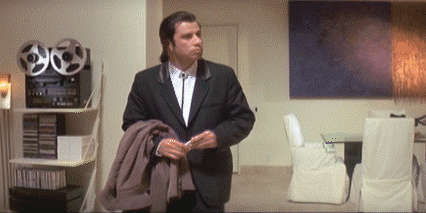
Scene- Vincent's first meeting with Mia:
- Mia's identity is revealed later, which portrays her as mysterious and elusive. the first shots of her are shots of her red lips convey her as lustful and seductive.
- the scene is carried by dietetic music and Mia's voice. this creates a seductive feeling and therefore portrays women as having sexual power due to their mysterious and assertive nature. Mia directs the scene by telling Vincent what to do and where to go. Tarantino often uses music to juxtapose the scene, which creates confusion for viewers.
- Vincent's movement and performance contrasts with Mia's. she is sat in-front of security cameras while smoking, showing her power and seduction, whereas he is shown to be sheepish and almost confused. he is directed by her, showing that he is submissive to her, and she is more dominant.
- Mia directs Vincent during the scene, conveying her control over the scene. Tarantino often gives women power in his films, often through their sexuality.
- Vincent is shown taking heroin before his date with Mia, which shows his nerves. this presents men as being less confident when around women, and contrasts with the way he is presented when killing people.when he is committing crimes he is shown to be calm and collected, whereas in this scene we can he is is hunched over, and looks around the room as if disorientated. this shows the contrast between his real character and the act he puts on when doing his job. it also shows how submissive men can become when in the presence of women.
-Mia is literally watching over Vincent, which provides a visual representation of her power and control over him.
Race:
Scene- final scene:
- Jules, who is a black character plays the act of the hero. this contrasts with stereo types of black people, depicted in film history. previously, black people were portrayed as incompetent or depraved, however Jules is portrayed as wise and thoughtful, and survives by the end of the film, unlike many white characters.
- black and white people are both shown to hold power, and are shown as partners and friends. This demonstrates the context of the film, and society was becoming increasingly integrated and minority groups were beginning to gain higher status positions in society an work.
Subscribe to:
Posts (Atom)
-
Representations: Gender: Scene- Vincent's first meeting with Mia: - Mia's identity is revealed later, which portrays her as m...
-
 scene analysis: motel massacre Editing: - shots are fast pace and don’t focus on one part of the killings in particular. This ...
-
constructivism believed art should directly reflect modern industrial world. focuses more on the importance of creating art rather than ...
