Friday, 1 June 2018
short film inspiration
Short Films:
Ideas form the short films that we watched that i appreciated and have used in order to inspire many of the aspects in my own short film:
Stutterer:
the internal thoughts of the protagonist allow the audience to view both the internal and external performance of the character. we see how a person can appear differently externally in front of others to how they really are internally. we connect with the protagonist primarily through listening to his internal thought process. without this we would, as the audience, be disconnected form the character, and would consequently mean that the final scene would become less effective. i took the idea of internal thought against external action and based my short film on this. the audience will also connect to the main character through her internal thought process, rather than her external set of actions.
Wasp:
the staggered and unfixed camera work is congruous with the lives of the characters on show. their lives are disjointed and arguably broken. we see this even from the beginning of the film, where a fight begins, and then through the rest of the story. the camera is evidently handheld and therefore reflects the characters impulsive and reckless actions, like the fight we see at the beginning. this technique of using the camera to reflect a certain situation or feeling is portrayed in my own short film.

Thursday, 3 May 2018
short film treatment
Short film ideas:
Idea 1:
the story will be centred around an interaction between a man and a woman who are on a first date. the audience will be able to hear one of the woman's internal thoughts, as if she is projecting her internal thoughts onto the audience. she will tell the audience her real identity, that she is a hit man who is on this date because she has been ordered by her boss to 'take care of his problem'. however, she will be telling the man that she is talking to that she is a completely different and ordinary person than who she reveals herself to be to the audience. this will slowly build tension for the audience, as we know who she really is, but at the same time will see how she lies to the man she is on a date with, and how she hides her true identity. when asked her occupation, he states that she is a secretary, and has to take care of jobs which her boss gives her. the audience will know that what she really means, however the man does not.
A woman to die for:
the protagonist, Julia, is shown walking towards a restaurant. she is dressed in smart cloths and heels. we gain a sense of her character through this opening scene, as she appears powerful and confident through her posture and severe expression.
she arrives at the restaurant and sits down opposite a man. he is also dressed in smart clothing, however contrasts Julia's confident appearance, as he appears shy and not quiet at ease. it is made clear that they are on a date by the way they greet each-other. the man asks Julia to tell him about herself. she reveals to him that she is a secretary, who takes care of any jobs her boss wants taken care of. we then hear her internal thoughts, which address the audience, and we are told that she is actually a completely different person, and is in-fact a professional hit man.
she then asks her date to tell him about himself, and he states his occupation, a dentist. she smiles at him, and at this point she tells the audience through her thoughts that this is the man that her boss has ordered to be killed, as he has been involved in drug exportation and her boss feels threatened by this. they continue their conversation of getting to know each other, and throughout their banal interactions we hear the woman's internal conversation with the audience. what she reveals to the audience constantly contradicts the information she reveals to her date. during the end, we see that her date is also planning on killing her or harming her, which leaves the audience with a cliff hanger.
Wednesday, 11 April 2018
Pulp Fiction Representations
Representations:
Gender:
Scene- Vincent's first meeting with Mia:
- Mia's identity is revealed later, which portrays her as mysterious and elusive. the first shots of her are shots of her red lips convey her as lustful and seductive.
- the scene is carried by dietetic music and Mia's voice. this creates a seductive feeling and therefore portrays women as having sexual power due to their mysterious and assertive nature. Mia directs the scene by telling Vincent what to do and where to go. Tarantino often uses music to juxtapose the scene, which creates confusion for viewers.
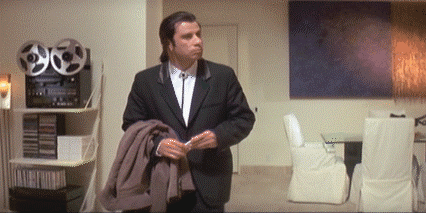
- Vincent's movement and performance contrasts with Mia's. she is sat in-front of security cameras while smoking, showing her power and seduction, whereas he is shown to be sheepish and almost confused. he is directed by her, showing that he is submissive to her, and she is more dominant.
- Mia directs Vincent during the scene, conveying her control over the scene. Tarantino often gives women power in his films, often through their sexuality.
- Vincent is shown taking heroin before his date with Mia, which shows his nerves. this presents men as being less confident when around women, and contrasts with the way he is presented when killing people.when he is committing crimes he is shown to be calm and collected, whereas in this scene we can he is is hunched over, and looks around the room as if disorientated. this shows the contrast between his real character and the act he puts on when doing his job. it also shows how submissive men can become when in the presence of women.
-Mia is literally watching over Vincent, which provides a visual representation of her power and control over him.
Race:
Scene- final scene:
- Jules, who is a black character plays the act of the hero. this contrasts with stereo types of black people, depicted in film history. previously, black people were portrayed as incompetent or depraved, however Jules is portrayed as wise and thoughtful, and survives by the end of the film, unlike many white characters.
- black and white people are both shown to hold power, and are shown as partners and friends. This demonstrates the context of the film, and society was becoming increasingly integrated and minority groups were beginning to gain higher status positions in society an work.
Indiewood
Indiewood:
The history of Indiewood is important when studying Pulp Fiction, as the film as created around the time when independent film was increasing in popularity. we can see many characteristics of independent film in Pulp Fiction.
during the 1980s, Hollywood reverted back to the studio era climate of the 30s and 40s. the corporate owners of the studios controlled the film businesses rather than the studio bosses themselves.gradually an alternate pathway emerged that gave independent filmmakers creative control (indiewood).
big budget Hollywood films are given a deadline and are subject to focus group viewings. independent films find their way to audiences through film festivals.
Hollywood characteristics:
- fantasy
- safe
- expensive
- genre specific
- studio gets final cut
- large scale
- sequels
independent characteristics:
- realism
- controversial
- low budget
- personal vision
- director gets final cut
- intimate
- unique
conglomerates:
- News Corporation (Fox/ searchlight)
-Sony (Columbia/ Tristar)
- Disney (Walt Disney/ Touchstone)
-Time Warner (Warner Bros/New line)
Wednesday, 28 March 2018
pulp fiction: opening sequence
pulp fiction opening scene:
The opening scene reveals necessary information about the film, and what can be expected in the rest of the film.
cinematography:
natural lighting used to create authenticity and realism. this was typical of post-modern independent films, as real life was portrayed through film rather than fantasy. the characters in the film are also raw and authentic, and have normal lives and problems, meaning the lighting reflects this authenticity.
 |
| again the camera faces up towards Jules, showing his dominance and power. |
performance:
casual conversation before violent killing which conveys the casual nature of violence in the film. their jobs and crimes and separate from themselves as a person, and their individual characters are not reflected in the work that they carry out. Tarantino wanted the audience to view the characters as normal people, not just assassins. their job is separate from their individual characters, and the audience can therefore relate with them and like their characters.

camera angles:
camera at low angle facing up to characters in order to portray their dominance and creates a feeling of intimidation. camera usually straight on when filming men and is fixed which shows their professionalism of them. this also suggests that they are used to committing violent acts. they are composed when committing crimes. the two characters are also equal in the shot, demonstrating their partnership, which was unusual, as black characters were usually portrayed as inferior in film history.

sound:
sound is elevated to the position and importance of a character. this is an auteur trait of Tarantino. opening sequence sets mood through sound for the audience, and the same music also plays on the radio in the car. Tarantino tells the audience how to feel throughout the film through his use of sound and music. often music will juxtapose a violent or disturbing scene, which means that the audience is unable to experience the scene in their own way, instead, the attributes of the scene direct the audiences feelings.
Tuesday, 6 March 2018
classical hollywood
Vertigo- classical Hollywood style:
classical Hollywood conveyed a unique and noticeable style. this style was portrayed through camera angling among other techniques. Vertigo also uses these same characteristics, as the film was made during the classical Hollywood period.
context:
-classical Hollywood generated a product with mass appeal and for mass consumption in an industrial context. The steady demand for new films made year-round production schedules necessary.
camera angling:
-The greatest rule of classical continuity regarding space is object permanence: the viewer must believe that the scene exists outside the shot of the cinematic frame to maintain the picture's realism. The treatment of space in classical Hollywood strives to hide the two-dimensionality of film ("invisible style") and is strongly centred upon the human body. The majority of shots in a classical film focus on gestures or facial expressions (medium-long and medium shots). André Bazin once compared classical film to a photographed play in that the events seem to exist objectively and that cameras only give us the best view of the whole play.

narrative:
-Classical Hollywood narration progresses through psychological motivation, i.e. by the will and agency of a human character and its struggle with obstacles towards a defined goal. This narrative is structured with an unmistakable beginning, middle and end, and generally there is a distinct resolution. The characters in Classical Hollywood Cinema have clearly definable traits, are active, and very goal oriented.
Power and Authority comparison
Power and Authority:
One Flew Over:
America has long made heroes of figures who assert their individuality, yet many American novelists have written about characters whose individualism conflicts with the societies around them. The character of Mcmurphy is also incongorous with the institution that he has been put into, as he represents the life and colour of the outside world, and the institution however is bereft of colour and joy. therefore Mcmurphy is presented as non-conformist and unwilling to accept authority. his non-conformity is evident in the first therapy scene where he is wearing colour whilst the other characters and the building is all white and dull.
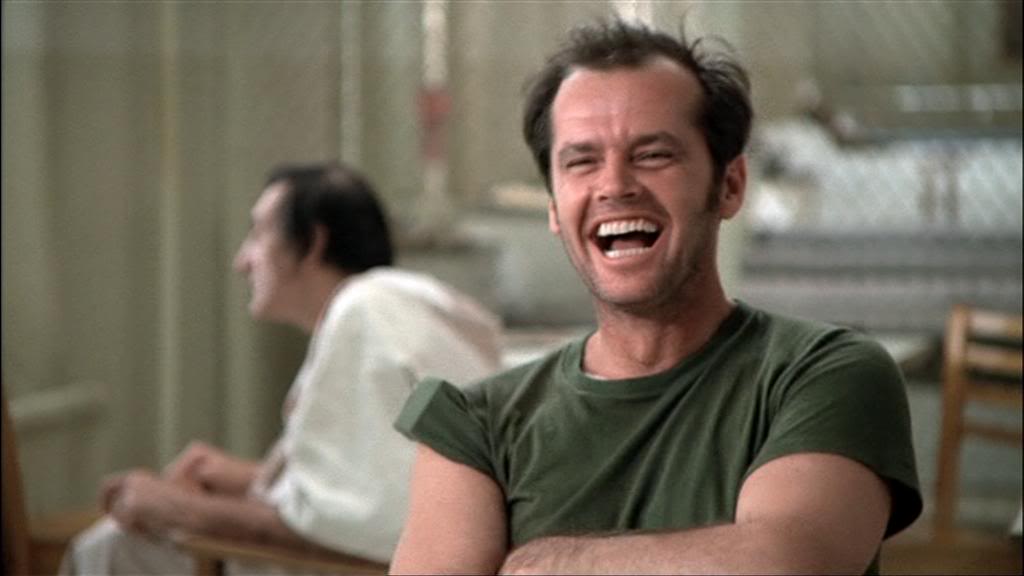

McMurphy is destruction to the status quo. he doesn't respect authorial figures e.g. when he addressed the doctor his language is informal. another example is his relationships with nurse Ratchet, as he is always the one questioning her power and decisions e.g. his demand to watch the world series. also when he enters the nurses office without permission. Nurse Ratchets unwillingness to allow patients to watch the world series shows the abuse of her power.
The film is notable for having men existing in a passive relationship with at leat one authoritative and controlling woman. she comes across as dominant when she is challenged. she is presented as the antagonist who thwarts McMurphy's goals and hope.
Forman previous film banned in his own country for shining a negative light on communism. this can be presented when Nurse Ratchet ignores the democratic vote of the patients, which can be linked to communism. power and authority is gained by the fear of nurse Ratchet.
Schatz argues that characters are now the main focal point in films whereas in classical Hollywood characters merely influenced the story line.
Vertigo:
In Vertigo power and authority are represented in a variety different ways in their text. One of the ways Vertigo does this is through the main character Scottie, Scottie is shown as a male authoritative figure throughout the film with his dominant expression and approach to women. One scene where this is very clear is when Scottie jumps into the river to save Madeline and the scene that follows, Scottie is shown as an Authoritative figure here because he takes action immediately jumping in to save the women. During the 1950's women were seen as lower in power than men with men being the most powerful in society. Going to the scene after this Scottie took Madeline back to his house and she is left powerless laying in the bed whilst Scottie makes her some tea. A common theme shown by most Hitchcock films is having a Blonde girl in it, this was usually done because Alfred Hitchcock liked blonde women and saw them as a tool in his films, someone who doesn't have any power except through sexual persuasions. However this is shown to be different in Vertigo where we find out Madeline had aided in the murder of Gavin's wife, when we find this out we get a completely different outlook on women power within the film and how women act as a hidden power often unseen by the audience.
Furthermore Scottie's misplaced in society, this is most present in his attempt to regain his authority after he lost is when Madeline died. his attempt at regaining control is presented as desperate and sad when he forces Judy to Dye her hair so she looks identical to Madeline because of the illusion created by the idea of helping madeline helps Scottie see himself as an authoritative figure which the time of the film was seen as being manly. Scottie tries to grasp onto his authority to try to fell secure in himself. This can be linked to the context of the film as 1950's America was a time of fear in which men were desperately trying to hold onto their power partially due to the rise of the 2nd wave of the feminist movement and the wars America fought; men are trying to recapture an outdated sense of authority.
Furthermore Scottie's misplaced in society, this is most present in his attempt to regain his authority after he lost is when Madeline died. his attempt at regaining control is presented as desperate and sad when he forces Judy to Dye her hair so she looks identical to Madeline because of the illusion created by the idea of helping madeline helps Scottie see himself as an authoritative figure which the time of the film was seen as being manly. Scottie tries to grasp onto his authority to try to fell secure in himself. This can be linked to the context of the film as 1950's America was a time of fear in which men were desperately trying to hold onto their power partially due to the rise of the 2nd wave of the feminist movement and the wars America fought; men are trying to recapture an outdated sense of authority.
The film can be read as a study of men trying to re-assert their control over women in post war America.
Subscribe to:
Posts (Atom)
-
Representations: Gender: Scene- Vincent's first meeting with Mia: - Mia's identity is revealed later, which portrays her as m...
-
 scene analysis: motel massacre Editing: - shots are fast pace and don’t focus on one part of the killings in particular. This ...
 -
Closing Scene: Editing - Slow motion used extensively, often with freeze frames of the key characters - Still images of Amy are of happi...
