Saturday, 23 June 2018

story board


film story board:

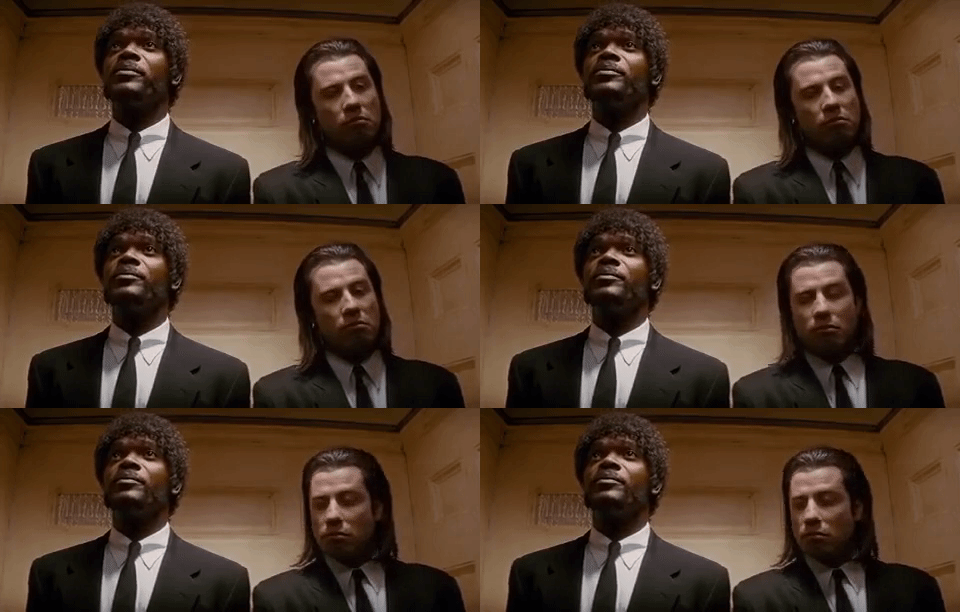
Creating this story board helped me to visualise the film before production, and therefore i could see if certain shots or angles were possible, and which ones most effective. 


Thursday, 21 June 2018

film script


Script: 

Writing the script meant that during production there was direction, and made the process quicker. it also allowed me to give the characters personality and certain traits which help develop the story.  During the process of writing the script, i decided on a different ending, which complemented the film more appropriately.  

The script begins with Julia walking to a blind date...


Friday, 1 June 2018

short film inspiration


Short Films:

Ideas form the short films that we watched that i appreciated and have used in order to inspire many of the aspects in my own short film:

Stutterer:
the internal thoughts of the protagonist allow the audience to view both the internal and external performance of the character. we see how a person can appear differently externally in front of others to how they really are internally. we connect with the protagonist primarily through listening to his internal thought process. without this we would, as the audience, be disconnected form the character, and would consequently mean that the final scene would become less effective. i took the idea of internal thought against external action and based my short film on this. the audience will also connect to the main character through her internal thought process, rather than her external set of actions.

Wasp:
the staggered and unfixed camera work is congruous with the lives of the characters on show. their lives are disjointed and arguably broken. we see this even from the beginning of the film, where a fight begins, and then through the rest of the story. the camera is evidently handheld and therefore reflects the characters impulsive and reckless actions, like the fight we see at the beginning. this technique of using the camera to reflect a certain situation or feeling is portrayed in my own short film.


Thursday, 3 May 2018

short film treatment


Short film ideas:

Idea 1:

the story will be centred around an interaction between a man and a woman who are on a first date. the audience will be able to hear one of the woman's internal thoughts, as if she is projecting her internal thoughts onto the audience. she will tell the audience her real identity, that she is a hit man who is on this date because she has been ordered by her boss to 'take care of his problem'. however, she will be telling the man that she is talking to that she is a completely different and ordinary person than who she reveals herself to be to the audience. this will slowly build tension for the audience, as we know who she really is, but at the same time will see how she lies to the man she is on a date with, and how she hides her true identity. when asked her occupation, he states that she is a secretary, and has to take care of jobs which her boss gives her. the audience will know that what she really means, however the man does not.

A woman to die for:

the protagonist, Julia, is shown walking towards a restaurant. she is dressed in smart cloths and heels. we gain a sense of her character through this opening scene, as she appears powerful and confident through her posture and severe expression.
she arrives at the restaurant and sits down opposite a man. he is also dressed in smart clothing, however contrasts Julia's confident appearance, as he appears shy and not quiet at ease. it is made clear that they are on a date by the way they greet each-other. the man asks Julia to tell him about herself. she reveals to him that she is a secretary, who takes care of any jobs her boss wants taken care of. we then hear her internal thoughts, which address the audience, and we are told that she is actually a completely different person, and is in-fact a professional hit man.
she then asks her date to tell him about himself, and he states his occupation, a dentist. she smiles at him, and at this point she tells the audience through her thoughts that this is the man that her boss has ordered to be killed, as he has been involved in drug exportation and her boss feels threatened by this. they continue their conversation of getting to know each other, and throughout their banal interactions we hear the woman's internal conversation with the audience. what she reveals to the audience constantly contradicts the information she reveals to her date. during the end, we see that her date is also planning on killing her or harming her, which leaves the audience with a cliff hanger.


Wednesday, 11 April 2018

Pulp Fiction Representations


Representations:

Gender:

Scene- Vincent's first meeting with Mia:

- Mia's identity is revealed later, which portrays her as mysterious and elusive. the first shots of her are shots of her red lips convey her as lustful and seductive.
- the scene is carried by dietetic music and Mia's voice. this creates a seductive feeling and therefore portrays women as having sexual power due to their mysterious and assertive nature. Mia directs the scene by telling Vincent what to do and where to go. Tarantino often uses music to juxtapose the scene, which creates confusion for viewers.
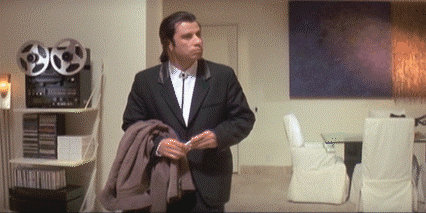
- Vincent's movement and performance contrasts with Mia's. she is sat in-front of security cameras while smoking, showing her power and seduction, whereas he is shown to be sheepish and almost confused. he is directed by her, showing that he is submissive to her, and she is more dominant.
- Mia directs Vincent during the scene, conveying her control over the scene. Tarantino often gives women power in his films, often through their sexuality.
- Vincent is shown taking heroin before his date with Mia, which shows his nerves. this presents men as being less confident when around women, and contrasts with the way he is presented when killing people.when he is committing crimes he is shown to be calm and collected, whereas in this scene we can he is is hunched over, and looks around the room as if disorientated. this shows the contrast between his real character and the act he puts on when doing his job. it also shows how submissive men can become when in the presence of women.
-Mia is literally watching over Vincent, which provides a visual representation of her power and control over him.
Related image

Race:

Scene- final scene:

- Jules, who is a black character plays the act of the hero. this contrasts with stereo types of black people, depicted in film history. previously, black people were portrayed as incompetent or depraved, however Jules is portrayed as wise and thoughtful, and survives by the end of the film, unlike many white characters.
- black and white people are both shown to hold power, and are shown as partners and friends. This demonstrates the context of the film, and society was becoming increasingly integrated and minority groups were beginning to gain higher status positions in society an work.


Indiewood


Indiewood:

The history of Indiewood is important when studying Pulp Fiction, as the film as created around the time when independent film was increasing in popularity. we can see many characteristics of independent film in Pulp Fiction. 

during the 1980s, Hollywood reverted back to the studio era climate of the 30s and 40s. the corporate owners of the studios controlled the film businesses rather than the studio bosses themselves.gradually an alternate pathway emerged that gave independent filmmakers creative control (indiewood).
big budget Hollywood films are given a deadline and are subject to focus group viewings. independent films find their way to audiences through film festivals.

Hollywood characteristics:                                     
- fantasy
- safe
- expensive
- genre specific
- studio gets final cut
- large scale
- sequels

independent characteristics:
- realism
- controversial
- low budget
- personal vision
- director gets final cut
- intimate
-  unique

conglomerates:
- News Corporation (Fox/ searchlight)
-Sony (Columbia/ Tristar)
- Disney (Walt Disney/ Touchstone)
-Time Warner (Warner Bros/New line)


Wednesday, 28 March 2018

pulp fiction: opening sequence


pulp fiction opening scene:

The opening scene reveals necessary information about the film, and what can be expected in the rest of the film. 

cinematography:

natural lighting used to create authenticity and realism. this was typical of post-modern independent films, as real life was portrayed through film rather than fantasy. the characters in the film are also raw and authentic, and have normal lives and problems, meaning the lighting reflects this authenticity.

Related image
again the camera faces up towards Jules, showing his dominance and power.

performance:

casual conversation before violent killing which conveys the casual nature of violence in the film. their jobs and crimes and separate from themselves as a person, and their individual characters are not reflected in the work that they carry out. Tarantino wanted the audience to view the characters as normal people, not just assassins. their job is separate from their individual characters, and the audience can therefore relate with them and like their characters.

Image result for vincent pulp fiction

camera angles:

camera at low angle facing up to characters in order to portray their dominance and creates a feeling of intimidation.  camera usually straight on when filming men and is fixed which shows their professionalism of them. this also suggests that they are used to committing violent acts. they are composed when committing crimes. the two characters are also equal in the shot, demonstrating their partnership, which was unusual, as black characters were usually portrayed as inferior in film history.

Image result for vincent pulp fiction

sound:

sound is elevated to the position and importance of  a character. this is an auteur trait of Tarantino. opening sequence sets mood through sound for the audience, and the same music also plays on the radio in the car. Tarantino tells the audience how to feel throughout the film through his use of sound and music. often music will juxtapose a violent or disturbing scene, which means that the audience is unable to experience the scene in their own way, instead, the attributes of the scene direct the audiences feelings.

Amy critical debate question

'Portable, digital cameras, digital sound recording equipment and non-linear digital editing have had a very significant impact on docu...